THE CARIBBEAN / EL CARIBE
THE CARIBBEAN
By Nicolás Guillén
Translated By Aaron Coleman
In the aquarium of the Great Zoo
the Caribbean slips by.
This animal,
enigmatic and maritime,
has a crest of crystal glass,
a blue back, a green tail,
an underbelly of compact coral,
and the gray fins of a hurricane.
On the aquarium, this inscription:
“Caution: it bites.”
Translated from the Spanish
EL CARIBE
By Nicolás Guillén
En el acuario del Gran Zoo,
nada el Caribe.
Este animal
marítimo y enigmático
tiene una cresta de cristal,
el lomo azul, la cola verde,
vientre de compacto coral,
grises aletas de ciclón.
En el acuario, esta inscripción:
“Cuidado: muerde”.
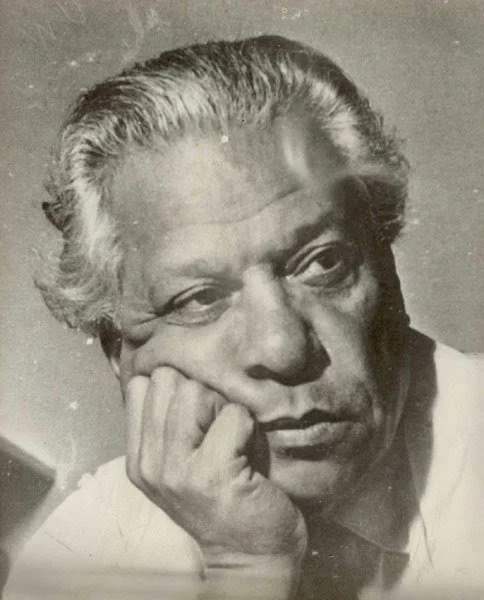
Nicolás Guillén
Born July 10, 1902, in Camagüey, Nicolás Guillén is among Cuba’s most significant 20th-century poets, a journalist, and a champion of Afro-Cuban people and culture. He became a pioneering voice of negrismo, blending Afro-Cuban rhythms, vernacular language, and musicality with modernist and surrealist techniques. Guillén began publishing socially conscious poetry as a teenager and went on to produce landmark collections such as Motivos de son (1930), El son entero (1947), and Tengo (1964). These poems helped establish Afro-Cuban culture in Cuban literature.
Throughout his career, he used his work to explore race, class, and national identity while engaging deeply with politics. He later supported the 1959 Cuban Revolution, when Fidel Castro and his revolutionary forces overthrew the Batista regime and established a socialist state. He was named National Poet of Cuba in 1961 and served as president of the National Cuban Writers' Union for over 25 years.
Today, he is remembered for merging Afro-Cuban tradition and political consciousness in writing to challenge racial discrimination wherever it occurred, particularly in Cuba and the United States.
